
What a Crypto Yield Farm Means
There’s a moment when an asset stops being idle cash and turns into a worker. A crypto yield farm is simply a way to put your coins to labour. You lend or lock them in a protocol and the system pays you back with rewards. I like to think of it as planting seeds, but the soil is a blockchain and the rain is trading fees.
If you search for paths to earn crypto online , this idea appears often. It is not alchemy. You surrender use of your tokens for a spell and take a cut of fees or newly minted tokens from the project.
Crypto farming is lending or locking assets in DeFi platforms to earn rewards.
The phrase crypto yield farm covers a bundle of methods. Some are simple holds where you park coins and wait. Others demand you watch prices and shuffle funds between pools. I will walk through the basics so you can decide if it fits - without the fog that normally clouds this terrain.
One thing I care about is plain talk. The source notes you do not need to be a crypto expert to try one, but you must know which pieces fit. That is why I break it down in ordinary words. A crypto yield farm can pay you, but the traits that make it tempting - high APR, a simple hold - can later make it brittle. Easier said than done.

Five Main Types of Yield Farming
The source splits the activity into five clear buckets. Each pays you differently. Here is the list so you see the shape of it before we dig into tokens.
Common farm types
- Liquidity provision on DEXs: you deposit token pairs so swaps can occur and you collect a share of those trade fees.
- Lending: you lend coins to a DeFi platform and earn a slice of the borrow interest paid by borrowers.
- Liquid staking or restaking: you help a network like Ethereum, Sui, BNB Chain, or Solana confirm blocks and earn rewards while keeping funds liquid via a yield-bearing token.
- Delta-neutral strategies: you deposit stablecoins for hedged farming and earn without price swing exposure, popularised by Ethena.
- Revenue-sharing: some projects hand you part of their income if you hold or stake their native token.
That is the core. You can mix them or stick to one. I suggest starting with the less complex ones until you get the hang of how a crypto yield farm breathes.
When you use a a smart contract platform for this, you trust code to mind your coins. So pick ones that have been audited and publish their docs. The rise of lending protocols such as Aave and stablecoin protocols like Ethena opened diverse ways to earn without relying on price bets.
Uniswap liquidity pools and yield farming basics
How to Pick a Token for Farming
Before you drop funds, look at five metrics the source used. They help you see if a token fits your crypto yield farm plan. I keep these on a sticky note.
Metrics to check
- APR: the current yearly return the farm shows for that token.
- Risk: technical risks like hacks, depegs, or smart contract bugs that could cost you capital.
- Token dump risk: the chance price falls hard when insiders or whales offload their stack.
- Token upside potential: room for the coin to appreciate and bring extra returns.
- Complexity: how hard the farm is to run day to day, from low to high.
I say start small. A crypto yield farm with high APR might look sweet but can fracture easily. Watch the edges, as the source says. If complexity is high, you will spend time monitoring instead of relaxing.
If you want to learn how to farm crypto , these metrics are your first lesson. Write them on a note by your screen and compare any token you find against them. No perfect token exists, so the call is yours.
Top Tokens Compared
The source picked five tokens to show the range. I will list them with rough APR and risk colour so you get a picture without a table.
Five tokens in the source
- $HYPE: around 50% APR, medium risk, high complexity, medium dump risk.
- $GOOD: around 67% APR, low risk, low complexity, medium dump risk.
- Stablecoins: around 9% APR, medium risk, low complexity, low dump risk.
- $BANANA: around 6% APR, low risk, low complexity, low dump risk.
- $SOL: around 8% APR, low risk, low complexity, medium dump risk.
Notice how stablecoins sit at low complexity but also low return. That is fine if you hate watching charts. A crypto yield farm with $GOOD looks friendly for newcomers because the APR is high and the steps are few.
There’s no perfect token for yield farming in crypto, which means the final decision is up to you.
The source adds that based on those five metrics, $GOOD and $HYPE with its growing ecosystem offer highest APR with simple type and small downside. But I remind you, high APR can drop fast if the pool empties. A crypto yield farm is living, not fixed.
$HYPE Token Farming on Hyperliquid

Hyperliquid is a perp DEX and L1 chain with apps built on HyperEVM. Folks farm $HYPE by providing liquidity to pools with stablecoins. For example, Hybra Finance offers concentrated liquidity on the $HYPE/USDT0 pair with yields up to 200% APR, but real return sits near 50–60% because price drifts out of range.
Risk is medium. No major hack reported yet, but many DEXs there are new, adding future exploit chance. The token is already large cap near $18.4B, so upside is limited. Complexity is high because you must watch price and understand V3 LP mechanics to earn steadily.
I would not start my first crypto yield farm here unless I had time to learn. But the ecosystem grows fast and some like it for the active play. Token dump risk is medium since supply is not dominated by whales, yet altcoins can fall in bear markets.
$GOOD Token and Revshare
goodcryptoX is a multi-chain DEX and CEX terminal. Its $GOOD token gives holders a revenue share around 67% APR with auto-compound on. You simply hold at least 10,000 tokens in the app wallet, no lock, and rewards arrive daily in USDC or GOOD.
Risk is low. The platform was audited by CertiK. The token rose about 6.77X early after launch and still has small market cap around $3M, so upside potential is high. Dump risk is medium because insider allocations were locked for six months at start, reducing sudden sell-off.
For a beginner crypto yield farm, this one looks calm. Complexity is low, which I love. An upcoming Hyperliquid integration could boost volume and APR further. Less than 20% of DEX functions released so far, leaving room to grow.
Yield farming versus staking explained in three minutes
Stablecoins as a Safe Farm Option
Stablecoins like USDC or USDT stay pegged to fiat or gold. Farming them means you avoid market swings. You can stake them in delta-neutral protocols like Ethena’s USDe and get about 9%, receiving a liquid token sUSDe you can use elsewhere.
Staking gives a yield-bearing token you can deposit in Pendle for extra APR near 12%, but stacking protocols adds exploit risk across Ethena and Pendle. Liquidity pool farming on Pancakeswap for USDT/USDC gives about 6% with less risk but lower return.
Remember, stablecoins cannot appreciate in value, and inflation eats real worth slowly. But for a crypto yield farm that lets you sleep at night, they fit. The main risks are protocol exploits and loss of peg, so check both the coin and the venue.
$BANANA Revenue Share Farm
Bananagun is a cross-chain DEX terminal with $BANANA token. Hold 50+ tokens (about $1,100) and get 40% of swap fee revenue. No lock, no protocol interaction, just hold in your Web3 wallet.
Risk low, APR around 6%, upside medium as it is not top 300 by cap but already largest revshare token in its niche. Dump risk low due to utility and big cap. Complexity low. It is one of the simplest crypto yield farm types I have seen.
If you already trade on such terminals, this is a no-brainer side earn. The revshare APR depends on volume and price, so a price dip naturally lifts APR and pulls new buyers. Neat balance.
$SOL and Solana Farming

$SOL is the token of Solana chain, a large alt L1. Native staking gives 6–10% APR, low risk. You can also use liquid staking or restaking to keep funds liquid and farm airdrops from those protocols.
Example: Solayer let users restake SOL at 8% and got airdrops from Sonic SVM. You can add LSTs to Meteora for extra yield. Complexity low for plain stake, higher for restake because LSTs can depeg.
SOL is top 5 by market cap near $130B so upside limited, but a crypto yield farm on it is steady. Even big coins face sharp corrections when sentiment turns bearish, so medium dump risk stays.
Other Platforms to Know
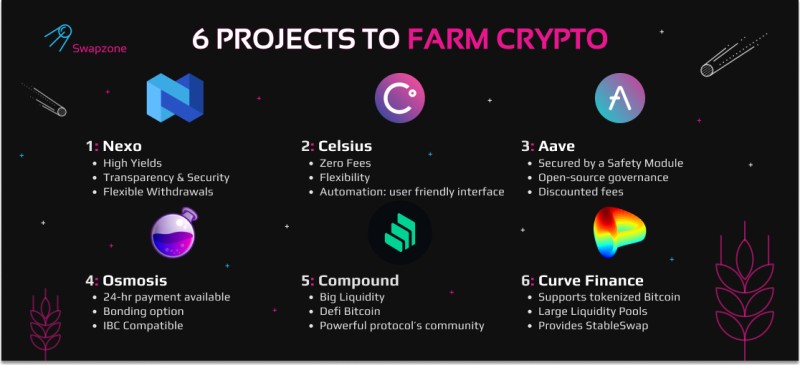
Beyond tokens, the source lists six projects that do yield farming well. I put them here so you see the spread across custodial and fully on-chain styles.
More farms to check
- Nexo: up to 8% on crypto, 12% on stablecoins, with real-time audits and up to $375M insurance, flexible withdrawals.
- Celsius: launched in 2017, holds large investment volume, offers 2%–18% on many products, zero fees on moves, supports 39 currencies.
- Aave: open-source lending protocol with $18.5B liquidity across networks, safety module staking as insurance against shortfall.
- Osmosis: AMM for IBC chains, easy LP choices with varied APYs, user-friendly interface.
- Compound: Ethereum pool with $10.2B supply, rewards cToken, decentralized governance.
- Curve Finance: AMM with near $19B deposits, good for stable pairs with minimal slippage.
These show a crypto yield farm can live on many chains and styles. Some are custodial like Nexo, others fully on-chain like Aave. Pick by your comfort with key control.
Common Farming Strategies
The source outlines effective approaches used across the space. I list them so you see the moves beyond single tokens.
Strategies that work
- Liquidity provision: supply pairs on DEXs like Uniswap or Curve and earn trade fees.
- Lending and borrowing: lend on Aave or Compound, earn interest from borrowers.
- Staking: lock tokens on PoS networks like Lido for ETH to earn validation rewards.
- Auto-compounding vaults: platforms like Yearn auto-reinvest rewards to maximise compound.
- Multi-chain farming: use bridges to find highest APY across Ethereum, Solana, Arbitrum.
A crypto yield farm often mixes these. For stablecoins typical APY 5–15%, for ETH or BTC 7–20%, for high-risk altcoins 30% plus but with volatility. Choose trusted platforms and diversify.
Yield Farming Versus Staking
People mix these up. Staking locks coins on proof-of-stake chains to secure network and earn fixed-ish rewards. Yield farming supplies assets to protocols for fees or tokens, often higher return but more work.
Key differences
- Risks: farming higher with impermanent loss, staking lower but still price drop and slashing.
- Source of yield: farming from trading fees plus token incentives, staking from network rewards.
- Complexity: farming active with pool switches, staking passive set-and-forget.
- Liquidity: farming often flexible withdrawals, staking may have unbond period of days or weeks.
- Token needs: farming requires pairs, staking needs single token.
I say if you want set-and-forget, stake. If you like tweaking, a crypto yield farm might excite you. Both can be part of plan. Fees differ too: farming has more gas when moving, staking has low overhead.
Neither is universally better; the choice depends on personal goals, risk tolerance, and desired returns.
Liquidity Mining Inside the Mix

The source clarifies words: yield farming is broad, staking is part of it, liquidity mining is a subset that rewards pool suppliers. So when you add coins to a DEX pool, that is liquidity mining, a type of crypto yield farm.
Knowing the terms helps you read docs without fog. You are not building a rocket, just learning the map. The chart in source shows overlap: liquidity mining fuels DeFi liquidity, yield farming maximizes returns, staking secures networks.
How to yield farm without getting rekt
How to Start a Crypto Yield Farm
First, pick a platform that fits your skill. Use a wallet like MetaMask or Trust Wallet. Then choose a token from the lists above with low complexity such as stablecoins or $GOOD.
If you wonder how to farm crypto , the step is: deposit, watch metrics, compound if offered. Start with small amount you can lose. The source says start small and watch the edges.
Don’t skip security. Check audits, use hardware wallet for big sums. A crypto yield farm is not a bank, you own the risk. Track yields with tools like DeBank so you see all positions in one view.
Keeping Your Funds Safer
Diversify across farms so one hack doesn’t sink you. Track yields with tools like CoinTracker or DeBank. I use them to see gas and allocs and avoid concentration risk.
Even things like flash loan crypto exploits have shown code can be tricked. So spread funds and stay informed on protocol news. Use secure wallets and never share keys.
Some crypto apps that promise free money are just bait. Real farming pays because you provide value, not because it is free lunch. If a deal sounds too sweet, step back.
Diversification, continuous education, and robust security practices are essential for a successful crypto yield strategy.
What Is a Token and Smart Contract
For new folks, what a token is in blockchain ? It is a unit of value issued on a chain, used for voting, fees, or share. In farming you often hold the project's token to get revshare or vote.
And what a smart contract platform is ? It is a chain that runs code automatically, like Ethereum or Solana. Your crypto yield farm lives there without a middle man, handled by code.
I am not here to teach how to build a cryptocurrency , but knowing the base helps you trust the system. A token with real utility supports price during dips, which matters for dump risk.
Tax and Legal Notes
I am no tax pro. But you might ask if staking crypto taxable events apply where you live. Rewards are often income when received. Check local rules before you farm big.
A crypto yield farm gain is still gain. Keep records of APR, dates of receipt, and token prices. That saves pain later. Lending interest and revshare both count as inflows in most places.
Looking at New Coins
You may chase the next big crypto coin for high APR. That is tempting but risky. A new token can dump fast and leave you with empty pool.
Some look at Ton cryptocurrency or others for farming. Fine, but treat as high complexity and watch dump risk. Small cap means big upside but also big fall.
My take: a slow crypto yield farm with known token beats a hype farm that vanishes. Start with the boring stuff, then branch if you learn.
What Makes a Farm Trustworthy
The source talks about how farms market. I care about audit reports, bug bounties, and clear emissions. A farm that shows real-time security status earns my nod. In the source, security-first messaging is listed as a top trust builder.
Community governance is nice too. If holders vote on fees, they care long term. That is a good sign for any crypto yield farm. Case studies show farms with transparent emissions kept 45% higher retention than rivals with same APY.
But beware hype alone. Transparency beats fancy words. A farm that invites outside analysts for real reviews builds more trust than one that pays for cheer. DYOR remains the mantra, as the source says.



Comments on “The Crypto Yield Farm: How to Put Coins to Work Without the Fog”
No comments yet. Be the first to share your thoughts.