
What The Crypto Long Term Capital Gains Tax Rate Means
There’s a moment in every crypto journey when the impulse to cash out collides with the tax code. We often talk about the tax implications of cryptocurrency and the mechanics of crypto taxation as if they were arcane. They aren’t. The crypto long term capital gains tax rate is simply the levy you owe when you sell an asset held beyond twelve months. The IRS treats crypto as property, not currency. That means each sale, trade, or swap is a taxable event. Hold past the one-year mark and you step off the ordinary income cliff into 0%, 15%, or 20%. Many sell too early and pay a premium for their impatience.
The headline number is the crypto long term capital gains tax rate. Federally, it lands at 0%, 15%, or 20%. Short-term gains, by contrast, are taxed as ordinary income - up to 37%. The gap is not trivial. A $10,000 gain realised at ten months might be clipped at 37%; held to fourteen months, it faces 20%. Patience is not just a virtue here; it is a line item. Then your state layers its own logic on top.
Speed kills your tax bill if you sell too soon.
This is not a game reserved for the wealthy. Anyone holding a token should respect the clock. I keep a quiet note on my phone: wait past the birthday of the buy. That single habit has spared me a chunk. The rules, once disassembled, are not so fearsome.
Taxable Events In Crypto

The IRS logs many actions as taxable. Selling for fiat is the obvious one. Swapping one token for another is a sale in their gaze. Even buying a coffee with crypto is a disposition. Yet purchasing crypto with dollars is not a taxable event. Moving coins between your own wallets escapes notice. Holding alone triggers nothing until you dispose. This corner of the mechanics of crypto taxation is where newcomers trip.
Actions That Create Tax
- Selling crypto for fiat money like USD
- Trading one crypto for another like BTC to ETH
- Using crypto to pay for goods or services
- Getting crypto as payment for work (ordinary income)
- Staking rewards and airdrops (ordinary income)
Some moves sit outside the tax net. Gifts may carry gift-rule baggage, but the recipient pays no tax. Donations to qualified charities are not gain events; often you deduct fair market value. Soft forks that yield no new tokens are silent. Pledging crypto as loan collateral does not trigger tax. Knowing these boundaries keeps the pulse steady at filing time.
And do not suppose the IRS misses crypto-to-crypto trades. They read a swap as two sales: you surrender one asset, receive another. The gain is proceeds minus your original basis. This is why a tracker earns its keep. Even if cash never enters your hands, the tax man expects his portion.
Three Legal Strategies to Minimize Crypto Exit Taxes
Short Term Versus Long Term
The dividing line is a single year. Hold a coin one year or less and it is short term, taxed at ordinary income rates. Cross that threshold and you earn the preferential long-term capital gains treatment for crypto of 0%, 15%, or 20%. The same gain taxed at 37% versus 20% is no small matter. I ran the numbers for a friend; the gap left him staring at the page.
The clock decides the tune when you sell.
Do not forget the states; some add their own twist, as we shall see. But the federal split is the first frame to understand. If you sit near the one-year line, a few extra weeks can alter the outcome. Price may wander, but the tax saving is concrete. Not advice - merely sense read from the regulations.
One more nuance: the holding period begins the day after acquisition. Buy on Jan 1 2022, and Jan 2 2023 is your first long-term day. Many miscount this. A simple spreadsheet date anchors it. I keep one for my own modest stash.
Federal Brackets For Long Term Gains

Here are the federal bands for long-term gains by filing status. The figures drift with inflation, but the architecture holds. Single filers enjoy 0% up to roughly $48k, 15% to $533k, then 20%. Married joint filers get 0% to $96k, 15% to $600k, then 20%. Head of household sits between. Thresholds vary slightly across guides, yet the tiers behave the same.
Long Term Rate Bands Example
- Single: 0% band up to $48,350, 15% to $533,400, 20% above
- Married joint: 0% to $96,700, 15% to $600,050, 20% above
- Married separate: 0% to $48,350, 15% to $300,000, 20% above
- Head of household: 0% to $64,750, 15% to $566,700, 20% above
High earners may owe an additional 3.8% net investment income tax atop the 20% - a wrinkle worth watching. Short-term rates track ordinary income brackets from 10% to 37%. The gap is stark. You might wonder what slice the taxman takes from crypto profit ? It hinges on your bracket and hold time. A quick calculation reveals the saving.
Some providers list alternate thresholds with slightly higher 15% caps. The precise numbers move with inflation. The key is the three tiers. If your taxable income sits low, you may pay zero on long-term gains - a sweet spot for small holders. I suspect more qualify than they realise.
State Wrinkles Like Washington
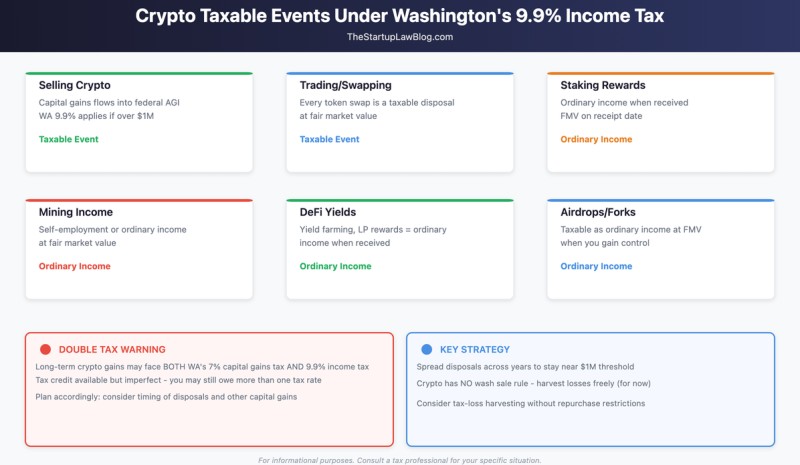
Some states write their own crypto tax rules. Washington state imposes a flat 9.9% income tax on adjusted gross income above $1 million, hitting short-term gains and ordinary crypto income. It also levies a separate capital gains tax on long-term gains. For long-term, gains are first lifted out of the income base, then a capital gains tax with bands at 7% and 9.9% applies. In effect, long-term gains there land near 9.9%.
Live in a no-income-tax state and you dodge that layer, yet federal rates remain. I raise Washington because it reveals how reporting crypto to the authorities tangles across borders. You must file the correct state form. Its credit prevents double tax. Other states may follow; keep eyes open.
Washington’s capital gains tax itself carries thresholds: single filers see 7% above $250k, then 9.9% above $1M; married joint gets 7% above $500k. The law is drafted so long-term gains are not struck twice - a rare nod to clarity. Still, you need solid records to prove which gain is which.
Beginner Guide to Crypto Taxes and Reporting
Cost Basis And Accounting Methods

Your cost basis is what you paid for the coin plus fees. At sale, gain is proceeds minus basis. The IRS lets you choose how to assign which coins you sold. FIFO means oldest sold first. LIFO means newest first. HIFO means highest cost first. Specific identification lets you pick exact units. This choice shifts your tax materially.
Ways To Track Which Coins Sold
- FIFO: old coins sold first, default if you do nothing
- LIFO: new coins sold first, can help in rising market
- HIFO: high cost coins sold first, often saves most tax
- Spec-ID: you pick units, must document each
You may change method year to year, but need IRS consent for a new one. Each wallet or exchange is a separate account for basis; the old pool method is extinct. Bear this in mind when using aids like a tracker such as Merlin to sort it. I tag each buy with a note to know the lot. It feels nerdy, but it saves cash.
One trick: use different methods per account if you wish. Allowed, so long as each is named and adhered to. FIFO on one exchange, HIFO on a cold wallet. The IRS wants consistency per account, not across all. This grants wiggle room to lower gains. Write it down before you file.
Capital Losses And Harvesting
Losses offset gains dollar for dollar. A net loss lets you deduct up to $3k against ordinary income ($1.5k if married separate). Surplus losses carry forward. This is tax-loss harvesting. Crypto sits outside the wash-sale rule for now, so you can sell at a loss and rebuy the same token immediately. Congress may close it; enjoy the opening while it lasts.
Crypto wash sale loophole is still open but watch it.
You can use different accounting per account to maximise offsets, allowed if each is named. I like this because it returns a measure of control. Some software offers free reports that tally your crypto tax to surface the numbers. Harvesting in a high-basis year preserves future gains - like storing rain for the drought.
And losses carry forward with no expiry. You never lose them. If you took a hit in a bleak year, apply it later when price blooms. That is the long game. I keep a slip with my leftover loss in the tax folder.
Special Rules For Staking Mining Airdrops DeFi NFTs
Many crypto actions carry their own tax tag. whether staking crypto is taxable is settled: it is ordinary income upon receipt. The fair market value that day becomes your basis. Mining mirrors this, reported on Schedule C if a business. Airdrops and hard forks are ordinary income when you control the tokens. They are not capital gains until you later sell the new tokens.
Activity Tax Notes
- Staking and yield: ordinary income at receipt
- Mining: ordinary income, can deduct costs
- DeFi swaps: every swap is a taxable disposition
- NFTs: collectible rate up to 28% federal long term
NFTs draw a special 28% max long-term rate. Buying an NFT with crypto is a sale of that crypto. Selling an NFT you created is self-employment income. DAOs may issue K-1s if partnership. Gifts and donations follow their own rules, but charity is not a gain event. This variety is why the labyrinth of crypto tax rules demands a cheat sheet.
DeFi liquidity pools add layers. Adding assets can be a taxable event when LP tokens arrive; their fair market value matters. Providing liquidity is not tax-free. I avoid complex pools because the paper trail daunts me. Simple holds are easier to track.
Reporting And Forms You Need
Brokers must file a designated form for crypto taxes called 1099-DA for sales and exchanges. It shows gross proceeds, not always basis. You still file Form 8949 per sale, then Schedule D sums it. Ordinary income from staking lands on Schedule 1 or C. State returns may add lines. The broker form is new and may miss data.
Never copy a 1099-DA without checking your own records.
Wallet-by-wallet accounting is required. The IRS wants per-account basis. Keep date, description, quantity, value, basis, fees. Digital records suffice if clear. Even PayPal’s crypto tax paperwork counts if you use that venue; they issue forms too. Matching is automatic, so mismatches draw notices fast.
You may also need Form 8283 for crypto gifts over $500 to charity. Gifts under the annual exclusion are fine for the receiver; the donor might file a gift return if large. These forms sound scary but are mere boxes. I fill them slowly with my CSV open. No rush needed.
Keep Good Records
Good records save you in an audit. Export CSVs from exchanges. Use block explorers to screenshot transactions. Keep bank statements for fiat proofs. A simple spreadsheet computes gains under your chosen method. Backup to cloud and offline. The IRS accepts paper if you can rebuild the trail.
Record Keeping Basics
- Date and time of each transaction
- Token symbol and exchange name
- Quantity and fair market value
- Cost basis including fees
The audit window is three years, longer for complex matters. Don’t toss records too soon. I keep mine in a folder labelled “crypto tax” with subfolders per year. It takes ten minutes a month - better than a panic at filing time. Trust me on this.
Screenshots of confirmation emails help, especially for large trades. If the exchange vanishes, your email is proof. Blockchain explorers show the hash. Pair that with your bank record and you hold a solid story. The key is chronology - keep things ordered by date.
Seven 2026 Strategies to Minimize Crypto Exit Taxes
Ways To Lower Your Tax Bill
Hold past one year for the lower crypto long term capital gains tax rate. Harvest losses to offset gains. Use a crypto IRA or solo 401k for tax-deferred growth. Donate crypto to dodge capital gain and deduct value. Entity structuring can cut state rates for business activity. Plain tools, not magic.
Strategies That Help
- Hold >1 year for 0-20% federal rates
- Tax loss harvesting up to 3k vs income
- Crypto IRA grows tax deferred or free
- Donate to charity, no gain, deduct value
Using high-basis lots first via Spec-ID or HIFO lowers gain. You must pick the method before the year starts. These are not guarantees; price can drop. But the tax shape sides with you if you wait. I like that it puts you in charge instead of the clock. Plan with a calculator, not a gut.
Another angle: time large sales to stay under state thresholds. In Washington, keep AGI under $1M to avoid the flat surcharge. That takes year-to-year modelling. A CPA helps if you are large. For small holders, the federal hold period is the main win. Keep it simple.
Common Pitfalls To Avoid
People miss crypto-to-crypto trades; the IRS sees them as sales. Mixing accounting methods raises flags. Relying only on 1099-DA is risky as it may miss basis. Ignoring staking income brings penalties. Assuming all crypto is simple property fails with NFTs and DeFi. These mistakes cost real money.
Underestimating the net investment income tax bites high earners.
Fixes are simple: track every swap, choose one method per account, keep your own records, report staking. If unsure, ask a tax pro who knows digital assets. I’ve seen folks frightened, but a little prep goes far. The most common miss is the tiny airdrop they forgot - it counts as income that day.
Another trap is treating the broker form as complete. It often lacks basis. You must still fill 8949 with your own numbers. The IRS matches proceeds, not your gain. A basis mismatch triggers a letter. Avoid the headache by self-reporting clean.
Simple Year End Checklist
Collect all CSVs and forms. Import to software, verify transactions. Select accounting method per wallet. Review gains and losses. Run the scenario: sell now versus wait 13 months. Generate 8949 and schedules. File state returns. Keep docs three years plus. Break it into small tasks and it is not bad.
Year End Steps
- Collect exchange and wallet exports
- Import and verify every transaction
- Pick accounting method per account
- Check gain vs loss, harvest if smart
- Generate forms and file state
That is a lot, but it breaks into small tasks. I do it monthly so year-end is light. You don’t need to be a pro, just consistent. The checklist is my friend. I tape it to the fridge in December. Old school, but it works.
And run that wait scenario. Sell a coin at eleven months and you pay short term. Wait one more month and the rate drops. Price risk is yours; the tax save is fixed. I ran this on a small ETH lot and kept an extra few hundred bucks. Not life-changing, but why hand it over?
Why I Think Holding Helps
The crypto long term capital gains tax rate rewards patience. Traders prize speed, but that can bruise at tax time. I’m not saying never sell. But knowing the rate shape helps you plan. The same coin can cost double in tax if sold early - real money left on the table. I write this as one person who reads the regs, not a firm.
And remember the ever-present tax on cryptocurrency is not going away. Rules shift, but the hold-period trick remains. Use free crypto tax report tools to model. Keep it simple, keep good notes. That is my two cents as a regular person. The long-term capital gains rate for crypto split is the closest thing to a free lunch in tax law. Take it.
One last note on the chore of tax reporting for crypto . The forms feel odd, but they are just paperwork. The IRS wants clarity, not gotcha. Report honest numbers and keep proof, and you sleep fine. I hope this piece helps you see the path. Now go check your hold dates.



Comments on “The Crypto Long Term Capital Gains Tax Rate: How the Twelve-Month Mark Reshapes Your Return”
No comments yet. Be the first to share your thoughts.