

What Crypto.com Apps Are
Crypto.com is a payment and cryptocurrency company founded in 2016. Its stated purpose is to accelerate the world's transition to cryptocurrency through products that let people buy, sell, hold, and use digital assets. The mobile app was introduced so users could buy or sell cryptocurrency directly from a smartphone, hold those assets as investments, or use them as a form of payment.
A later description calls Crypto.com a payment, cryptocurrency, and NFT platform that supports buying, selling, and paying with crypto. When you look for the best app for crypto , the question is really about which one fits your daily habit. A buy and sell crypto app should make it easy to move between purchasing, holding, and spending without friction. Crypto.com Pay accepts several wallets including the Crypto.com App, MetaMask, and WalletConnect-compatible options like DeFi Wallet, imToken, and Ledger.
Product Surfaces and What They Do
The documented product surfaces include the consumer mobile app, Crypto.com Pay, a Payment SDK for web apps, and Exchange API tooling. The API also has separate agent skills for app-based trading and exchange trading. When you look for apps where you can buy crypto , the choice depends on which surface fits your habit.
The mobile app handles buying, selling, and holding. The Pay SDK handles checkout flows. The API handles automated trading and balance checks. A crypto currency trading platform needs all three surfaces working together, and that is where the experience either clicks or falls apart.
Crypto.com describes its purpose as accelerating the world's transition to cryptocurrency through products that let people buy, sell, hold, and use digital assets.
Mobile App Redesign

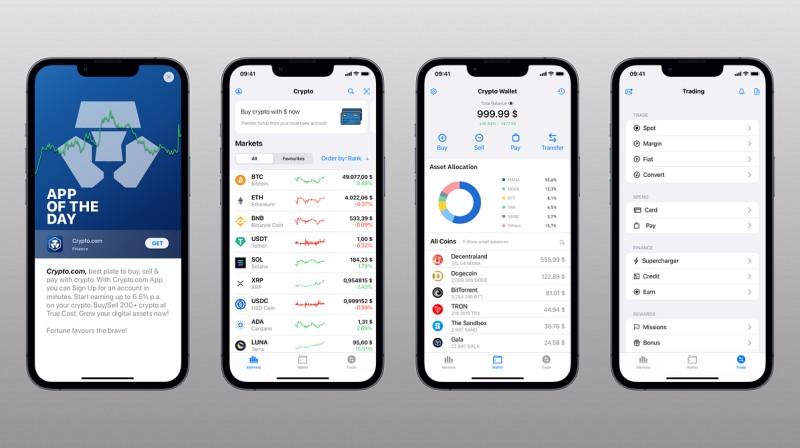
Vincenzo Pascarella proposed a SwiftUI redesign on December 27, 2021, based on UX research. The aim was to improve intuitiveness, remove redundancies, use different colors, and follow Apple Human Interface Guidelines. The proposal focused on familiar patterns, clearer hierarchy, persistent global navigation, and placing financial information where it is most relevant.
The redesign matters because even an experienced cryptocurrency user can be confused by a flow that is not linear. Repeated navigation choices can make information architecture harder to understand. Displaying "Total Balance" in most sections may also frustrate users who only want a section-specific feature.
Consistency creates familiarity and a sense of control. A consistent app should implement familiar standards, uniform elements, popular patterns, and recognizable interactions.
Crypto.com beginner tutorial and account setup
Navigation and Tab Bar
Apple's Human Interface Guidelines call for the minimum number of tabs needed, ordered by importance, to clarify the information hierarchy. Hiding the tab bar while navigating should be avoided unless the destination is a modal view. The large blue center button opened a list of complex financial tasks rather than a modal for a simple task, and hiding the tab bar in that flow removed the user's global navigation control.
The proposed tab bar changes are straightforward: "Home" was removed because it can be confused with the device home screen. "Markets" replaced both "Home" and "Track." "Wallet" replaced "Accounts." The large blue center button became "Trade." The "Card" tab was removed because Card was already in the Trade view.
Tab Bar Changes
- Home removed - confused with device home screen
- Markets replaced Home and Track
- Wallet replaced Accounts
- Trade replaced the large center button
- Card tab removed - already in Trade view
Markets View
The Markets view combines the old Home and Track views. Its navigation bar has three controls: account settings, coin search, and QR code scanning for send, pay, or receive. Total Balance was removed from Markets. A horizontal news section was added for promotions and partnerships. A segmented control lets you switch between "All" and "Favourites" cryptocurrencies. A sorting button gives direct control over what appears.
Wallet View
The Wallet view shows asset allocation and lets you access individual crypto wallet details with one tap. Wallet replaces the previous Accounts section. Older account options were removed because they duplicated choices in Trade. Total Balance is displayed only in Wallet, not repeated across unrelated areas. Quick-action buttons appear below it, and the owned-cryptocurrency list is separated from the balance display by an asset-allocation pie chart with percentage details.
Trading Features
The Trade section replaces the list opened by the large center button. It introduces additional trading features and replaces less familiar symbols with familiar SF Symbols. The navigation bar places a message inbox on the left. Two controls on the right open notifications and trading activity records. The proposed list uses a native pattern and keeps the tab bar visible, so users retain global navigation while moving through trading tasks.
For the best apps for trading crypto , the trading section should feel native and keep navigation accessible. A cryptocurrency trade app needs to make order placement feel simple while still offering depth. "Small changes eventually add up to huge results."
Small changes eventually add up to huge results.
Crypto.com Pay
Crypto.com Pay supports an expanding set of cryptocurrency payment methods. An e-commerce demo showed the payment flow from selecting a product through checkout with Crypto.com Pay. The common payment scenarios involved the Crypto.com App, MetaMask or another WalletConnect wallet, and another cryptocurrency wallet.
During payment, the page needs real-time feedback such as on-chain information and transaction data. The then-current technical implementation did not always deliver that data on time. Delayed data compromised the payment experience and increased server-side maintenance costs.
Real-Time Payment Architecture
Crypto.com's engineering process emphasizes timely refactoring and reducing technical debt. The company rarely schedules a complete rewrite. Instead, refactoring and optimization are incorporated into product objectives. As payment features expanded, the implementation was generalized to support future payment methods.
The web payment applications needed real-time data. The client previously requested updates at fixed intervals through polling, which introduced problems. HTTP polling repeatedly checks the server, every request consumes server resources. Long- and short-polling responses cannot remain reliably synchronized when several data sources are involved. Opening a polling connection can require three network round trips: TCP SYN, SSL negotiation, and data transfer.
CEO app rebranding and CRO buyback news
WebSockets and SSE
A WebSocket is a persistent, two-way TCP connection between server and client. The server can push an event without first receiving a request. Server-Sent Events, or SSE, are based on Server-Sent DOM Events and were first implemented in Opera 9. In SSE, a browser subscribes to a stream of events generated by a server and receives an update whenever a new event occurs.
WebSockets offer operational advantages. They generally do not use XMLHttpRequest, so headers do not have to be sent with every request. They can transmit both binary data and UTF-8 data. WebSocket support was available across all major browsers by 2020.
SSE is transported over ordinary HTTP instead of a custom protocol. It includes built-in reconnection and event-ID support. SSE is limited to UTF-8 and does not support binary data. Its simultaneous connections are restricted by a browser-level limit of approximately six per browser, which can be problematic when users open multiple tabs. SSE is also one-directional.
WebSockets were selected as the more versatile framework despite greater initial work. The choice was framed partly as a question of technical debt - not inherently bad, but can become more expensive later.
Socket.IO as a WebSocket Wrapper
Socket.IO can be viewed as a client-side wrapper around the WebSocket API. Its codebase has two layers: Engine.IO is the low-level connection layer, and Socket.IO provides the higher-level API. Socket.IO adds capabilities beyond plain WebSockets. It can fall back to HTTP long-polling when a WebSocket connection cannot be established. It supports automatic reconnection and packet buffering. It provides acknowledgments. It can broadcast to every client or to a subset in a "Room." It can separate channels through multiplexing, called a "Namespace."
Socket.IO Capabilities
- Fallback to HTTP long-polling
- Automatic reconnection
- Packet buffering
- Broadcast to all clients or a Room
- Channel separation through Namespace
Next.js WebSocket Integration
The Crypto.com web application was built with Next.js. The browser's WebSocket object is not available on the server. Two approaches were considered: fetch data on the server then update through WebSocket in the browser, or set up a WebSocket client in Node.js. The first approach was selected: WebSocket integration with polling as a client-side fallback.
The intended result was more responsive payment data, lower server-resource consumption as usage grows, and payment infrastructure that would not become a bottleneck. An unsuccessful direct WebSocket connection was described as causing at least 10 seconds of waiting before real-time data exchange begins, which can harm the user experience.
Error Handling and Authentication
Before the major refactor, Crypto.com established reconnect strategy including the number of attempts and intervals between them. Socket.IO handles heartbeats automatically with pingInterval and pingTimeout configuration. A known issue affected browser tabs not in focus. Some browsers throttle JavaScript timers. In Socket.IO v2, the client-side heartbeat depended on setTimeout, so throttling could cause a ping timeout and disconnection.
Socket.IO v4 reverses the heartbeat mechanism so the server sends ping packets. Neither WebSocket nor Socket.IO automatically carries the authorization state of the page. The browser's native WebSocket client cannot send arbitrary HTTP headers. Socket.IO can send custom headers when polling transport is enabled, which is the default.
The documented client configuration sends custom headers through polling transport. The corresponding server middleware reads the header and validates it. This separate authentication step is necessary because a WebSocket opened behind an authenticated page does not automatically receive that authentication.
API Agent Trading
A public repository provides agent skills for cryptocurrency trading through Crypto.com APIs. It works with platforms that support SKILL.md, including OpenClaw, Cursor, Claude Code, and other compatible agents. The repository has two independent skills. The crypto-com-app skill executes trades, checks balances, and queries token prices through the Crypto.com App. The crypto-com-exchange skill does the same through Crypto.com Exchange.
For crypto trading bots , the App skill supports market buys, sells, swaps, and exchanges across more than 200 tokens, including BTC, ETH, and CRO. It can query fiat and cryptocurrency portfolio holdings, discover coins, and check market prices. The skill can view recent transaction history and check weekly trading-budget usage. An emergency API-key revocation kill switch is included.
App Skill Capabilities
- Market buys, sells, swaps, and exchanges across 200+ tokens
- Query fiat and crypto portfolio holdings
- View transaction history and trading-budget usage
- Emergency API-key revocation kill switch
- Cash-management: deposits, withdrawals, bank accounts
Trading Bot Examples
A request to buy CRO with 100 USD produces a quote for confirmation. After confirmation, the agent reports the purchase. A balance request returns both crypto and fiat holdings. A swap request produces a 15-second quote. If the quantity changes, the agent creates a new quote. After explicit confirmation, the trade executes.
A coinbase trading bot free approach would be one where the user sets up automated trades without paying for premium signals. The Crypto.com App skill uses API credentials and HMAC-SHA256 signing to secure requests. API keys are read only from environment variables and are never stored in files.
A basic trading workflow begins by checking the balance, then obtaining a quote, and finally confirming the trade.
Exchange Agent Skill
The Exchange skill can place, amend, and cancel limit and market orders. It supports stop-loss, stop-limit, take-profit, and take-profit-limit orders. It manages OCO, OTO, and OTOCO order groups. It can query balances, positions, order history, and trade history, and can withdraw funds and check deposit or withdrawal status.
The skill contains 52 endpoints covering public market data, private trading, advanced orders, wallet functions, and account management. Every endpoint was verified against the live API using real orders. The documentation includes 66 edge cases covering parameter types, pagination quirks, error codes, and validation rules.
Exchange Skill Features
- Limit and market orders
- Stop-loss and take-profit orders
- OCO, OTO, OTOCO order groups
- Balance, position, order, and trade history
- Withdraw funds and check deposit status
Daily Engagement Systems
Finance and crypto apps frequently use game-design mechanics such as streaks, experience points, quests, achievement tiers, daily missions, surprise events, and progression systems. The stated purpose is to give users reasons to return each day and make closing the app feel like they are missing something, rather than turning finance or cryptocurrency products into games themselves.
Crypto.com is presented as a case study in progression systems. Its reward design includes Daily Missions, Streak Bonuses, Achievement Tiers, onboarding tasks, and a diamond-based economy. Missions and onboarding tasks can award diamonds. Achievement tiers support intrinsic motivation, while the Diamond Store offers randomized rewards. Streak bonuses create a recurring reason to return when market prices are not moving.
Public data on Crypto.com's engagement results was described as limited and inconsistent, making the effects difficult to quantify with hard numbers. The feature set nevertheless demonstrates an attempt to reduce dependence on market volatility by giving users market-independent reasons to engage. A native crypto market app needs engagement systems that work regardless of price swings.
Crypto.com review as a crypto investing app
Comparing with Other Habit-Forming Apps
Jared Gibbons's "Features Worth Stealing" analysis examined Duolingo, DraftKings, Crypto.com, Tinder, and BeReal through engagement features, reward systems, and motivational design. The analysis treats gamification as a strategic system rather than an automatic fix. Cryptocurrencies trading platforms face the same challenge as any app: how to keep users returning when the core activity is volatile.
Duolingo's streaks, experience points, and leaderboards made language learning resemble a game, but some users argued that the app rewarded drills without producing real mastery. Duolingo Max added Roleplay Mode, Explain My Answer, and Video Call Lessons for deeper learning. The analysis reported improved retention as users faced conversational challenges requiring more investment.
DraftKings added a social layer around the bet, check, and settle loop. Bet Feed provides streams of real-time wagers. Betting Groups build communities around shared picks. Pools turn predictions into social contests and leaderboard races. These features are intended to make sports interaction a community ritual throughout the year.
Crypto engagement has historically reacted to market conditions. Users may increase activity during price rises, sell during declines, or return after a major listing. Crypto.com's Daily Missions, Streak Bonuses, Achievement Tiers, onboarding tasks, and diamond rewards provide recurring objectives independently of short-term price movement. The objective is to flatten activity curves by combining extrinsic rewards, visible progress, and recurring tasks.
Tinder introduced LiveOps-style features like Swipe Night, Vibes, Swipe Surge, and The Game Game. These created short periods of variety but did not change the central match, chat, and date loop. BeReal expanded to infinite posting and algorithmic feeds after acquisition, but the expansion lacked cohesive pacing and reward structures. More features do not automatically create engagement when they are not integrated into the original habit.
Habit-First Design Principles
The comparison emphasizes defining the intended daily habit before assembling individual features. A streak functions as more than a counter when it is embedded in a loop that builds identity and progress. A social feed provides more value when it reinforces the primary reason for returning.
Successful mechanics connect features into a coherent system that guides behavior and rewards commitment. Crypto.com's missions, streaks, tiers, and diamond economy are intended to make engagement habitual rather than exclusively market-driven. DraftKings connects sports activity to shared rituals. Duolingo connects progression to genuine learning. Tinder and BeReal demonstrate the risk of adding novelty without also developing the core loop or preserving the original habit.
Social Media Practices
Ish Verduzco's August 16, 2024 guide addresses startup social media rather than the internal interface of a finance app. It covers building a company's public presence from zero, choosing platforms, finding a voice, establishing cadence, and measuring results. Social platforms can help startups research audiences, drive organic growth, build brands, and increase awareness.
The guide warns against fully outsourcing social presence to AI because automated accounts can lose context and personal detail. Readers may be able to tell that no person is operating the account, which can reduce trust and engagement. For a native crypto market app , the public face matters as much as the product itself.
Social Media Priorities
- Quality > Consistency > Quantity
- Choose one or two platforms, develop strong habits
- Use personal accounts as well as company accounts
- Measure both quantitative and qualitative results
- Respond to comments to increase visibility
Technical Implementation Details
The application uses a variant of the publish/subscribe pattern within React. A WebSocket data-source Provider receives initial data from server-side rendering. The Provider fuses server-rendered data with WebSocket updates and exposes this to subscribers. A useSocket hook and WebSocket.Consumer act as subscription mechanisms. The WebSocket.Provider acts as the publisher, while the hook and Consumer act as subscribers.
Several unresolved questions remained. The team considered whether one WebSocket instance could persist when Next.js root pages changed. The team had not yet fully used the duplex capability for other interaction flows. React server components were identified as a possible way to make the application more interactive.
The checkout flow includes a countdown showing users how much time remains to pay. It was implemented in pure browser JavaScript, but its remaining-time calculation was often inaccurate. Inactive browser tabs receive lower execution priority, which affects JavaScript timers. setTimeout() and setInterval() have no accuracy guarantees. They may lag by arbitrary amounts, do not maintain a constant pace, and drift over time.
The proposed approach was to use the Date object for millisecond-accurate current time. The timer logic would use the current time value instead of counting how often the callback executed. This would create a relatively accurate timer with automatic correction when deviations occurred.
The then-current technical implementation did not always deliver data on time. Delayed data compromised the payment experience and increased server-side maintenance costs.
Security and API Credentials
The App skill requires Node.js 18 or later and a Crypto.com App account with an API key and secret. The documented security controls establish that the App API key has no withdrawal permissions and can only trade. A configurable weekly trading limit acts as a guardrail against runaway spending. All requests use HMAC-SHA256 signing to prevent tampering and replay attacks.
API keys are read only from environment variables and are never stored in files. A kill switch can revoke API access immediately in an emergency. For the Exchange skill, production trades require explicit confirmation by typing "CONFIRM". API keys and secrets are masked and never displayed in full. API keys can be restricted to specific IP addresses for production. Withdrawal destination addresses must be pre-approved in Exchange account settings.
Security Controls
- HMAC-SHA256 signing for all requests
- API keys from environment variables only
- No withdrawal permissions on App API key
- Configurable weekly trading limit
- Emergency kill switch for API access
- Pre-approved withdrawal addresses on Exchange


Comments on “How Crypto.com Apps Compare on Design, Payments, Trading, and Daily Use”
No comments yet. Be the first to share your thoughts.